
To start playing drums, a pair of 5A hickory sticks with a wood tip suits the vast majority of students. For a child aged 6 to 9, a thinner, shorter pair is better: 7A or junior size.
That’s the short answer. But in a music shop, the choice can quickly get confusing: dozens of models, numbers and letters, different woods and tips. In this article, our drum teachers explain what it all means, so you can choose your first pair of sticks with confidence.
7A, 5A, 5B, 2B: what do these codes mean?
A stick’s code tells you its thickness and weight. The lower the number, the thicker and heavier the stick. A 2B is therefore much heavier than a 7A.
The letter comes from the sticks’ original use. A stood for orchestra, B for band (brass bands and louder groups), and S for street (marching). Today, just remember that a B is thicker than an A with the same number.
| Size | Approximate diameter | Feel | Who it suits |
|---|---|---|---|
| 7A | about 13.5 to 14 mm | Thin and light | Kids, small hands, jazz, soft playing |
| 5A | about 14.5 mm | Balanced | The all-round choice for beginners, all styles |
| 5B | about 15 mm | Thicker and heavier | Rock, louder playing, large hands |
| 2B | about 16 mm | Very heavy | Rock and metal, building endurance |
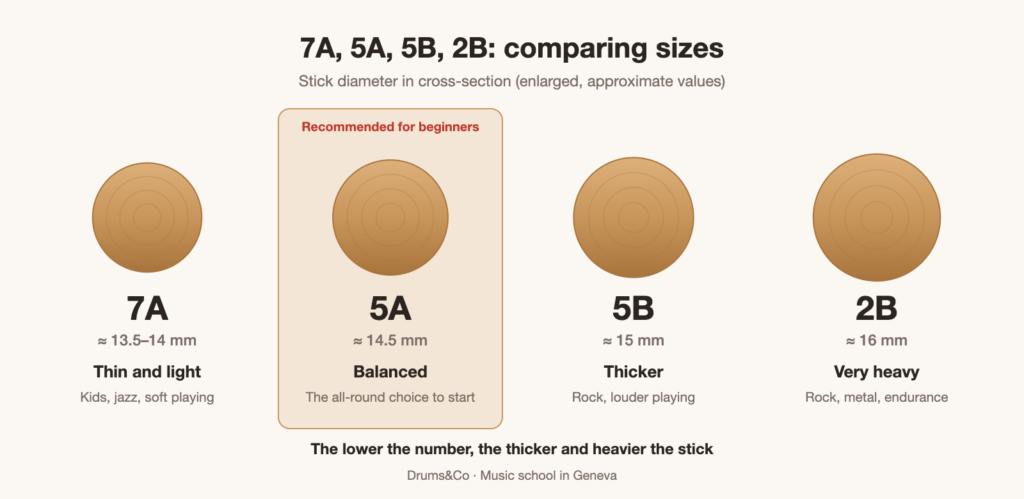
Dimensions vary slightly from brand to brand: one maker’s 5A may feel thicker than another’s. That’s why it’s worth trying sticks in your hands before buying.
Wood, tip and taper
Beyond size, three details change how the sticks feel and sound.
The wood
- Hickory: the most common. It’s strong and absorbs vibrations well, which is easier on the wrists. This is our recommendation for beginners.
- Maple: lighter and more flexible. Pleasant for soft playing or young students, but it wears out faster.
- Oak: denser and heavier. Very durable, but it sends more vibration into the hands.
The tip
The tip is the end of the stick that strikes the cymbals and drums. Its shape mostly changes the sound on cymbals.
- Oval or teardrop: fairly rich, versatile sound. A great choice to start with.
- Round (ball): precise, articulate sound on the ride cymbal.
- Barrel or acorn: broader, more powerful sound.
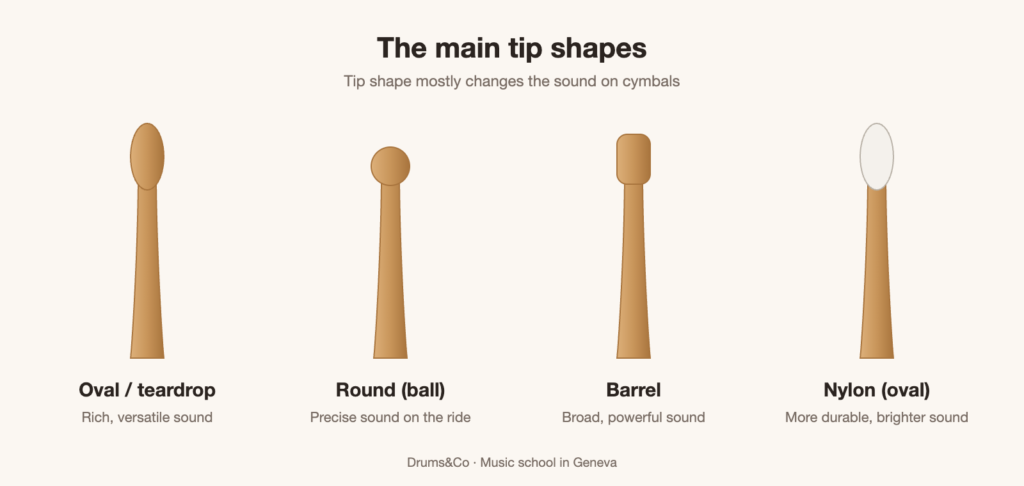
Tips come in wood or nylon. Nylon wears more slowly and sounds brighter on cymbals. Wood sounds warmer but eventually chips. For beginners, both work: pick the one you like the sound of.
The taper
The taper is where the stick narrows towards the tip. A long taper makes a more flexible stick with more rebound, ideal for speed and finesse. A short taper makes a stiffer stick that handles powerful playing better. Standard models have a medium taper, which is perfect for beginners.
Our recommendations by student
| Profile | Our advice |
|---|---|
| Child aged 6 to 9 | Junior (shorter) sticks or 7A, in hickory or maple |
| Child aged 10 to 13 | 7A, then 5A once the hands have grown |
| Teen or adult beginner | 5A hickory, oval tip in wood or nylon |
| Into rock and powerful playing | 5B hickory |
| Into jazz or subtle playing | 7A, round tip |
| Practising at home in a flat | 5A for the practice pad, and rods to play more quietly on a kit |
Whatever your profile, the best move is to talk to your teacher. At Drums&Co, our teachers look at hand size, posture and the style you play to guide you. And during drum lessons, you can try several models before buying.
No drum kit at home yet? School students get free access to our three practice rooms all week. A pair of sticks is all you need to come and practise.
Which drumstick brands should you choose?
For beginners, a standard pair from a well-known brand is more than enough. These are the brands you’ll see most often in shops:
| Brand | Origin | What to know |
|---|---|---|
| Agner | Switzerland | Swiss maker founded in 1985, with sticks produced in Switzerland. Wide range of models, from beginner to professional. |
| Vic Firth | United States | Probably the most widespread brand. Its 5A hickory is a standard in music schools. |
| Promark | United States | Very wide range in hickory, oak or maple, with wood or nylon tips. |
| Vater | United States | Known for durable sticks, with many models between the classic sizes. |
| Zildjian | United States | The famous cymbal maker also produces sticks, including signature models. |
| Los Cabos | Canada | Good value for money, with lighter maple models. |
| Wincent | Sweden | Valued for their consistency from one pair to the next. |
The same size can feel a little different from one brand to another. The safest bet is to try a few pairs in your hands, or ask your teacher for advice.
Choosing in the shop, and making your sticks last
A few simple checks in the shop help you avoid bad surprises:
- Check they’re straight. Roll each stick on the counter: if it wobbles or bounces, it’s warped.
- Compare the pair. Both sticks should weigh the same in your hands. Tap them on the counter: they should sound similar.
- Test the grip. Hold them as you would in a lesson and play a few strokes on a pad. They shouldn’t slip or feel too heavy after a minute.
- Choose the finish. Lacquered, natural or with a grip coating: it’s a matter of comfort. If your hands sweat, a natural or grip finish helps.
Sticks wear out, and that’s normal. Replace a stick as soon as it splinters or cracks: it can hurt you and damage your drumheads. To make sticks last, hit cymbals with the side of the stick rather than the tip, and rotate your sticks in your hands regularly to spread the wear. Keep a spare pair in your bag too.
Frequently asked questions
5A or 7A: which is best for beginners?
For teens and adults, 5A is the most versatile. 7A is better suited to children, small hands and soft playing.
How much does a pair of drumsticks cost?
A standard pair of drumsticks generally costs between 15 and 25 Swiss francs. There’s no need for the most expensive model to start: a standard pair from a well-known brand does the job very well.
How often should you change your sticks?
It depends on how much and how hard you play. Change them as soon as they splinter, crack or the tip gets damaged.
Do you need special sticks for an electronic kit?
No, regular sticks are fine. Nylon tips wear more slowly on rubber pads.
Ready to get started?
At Drums&Co in Geneva, we welcome drummers from age 6, with no upper age limit, in private or group lessons. Our teachers advise you on gear from the very first lesson, and you can come and practise for free in our practice rooms all week.
Discover our drum lessons · Rates and registration
Also worth reading: phonetic rhythm solfège, the method that helps our students read and feel rhythm (learn more).
Written by Ismaël Rodriguez, drum teacher at Drums&Co in Geneva.